
User-generated content is usually treated like a branding or social media tactic. But for modern SEO teams, it’s a scalable organic growth engine built directly into the pages that drive revenue.
If you’re responsible for organic performance, this probably feels familiar:
At some point, publishing more blog posts or making incremental tweaks stops moving the needle. Scaling headcount isn’t always realistic. And marginal technical gains rarely unlock step-change growth.
That’s where UGC marketing changes the equation.
It allows you to scale content without scaling costs, strengthen relevance and built-in social proof, and turn customers into ongoing contributors to your search visibility.
In this guide, you’ll discover nine practical, execution-ready ways to use user-generated content to increase rankings, improve engagement, lift conversions, and drive measurable ROI.
The focus is simple: how to operationalize indexable UGC inside your core SEO pages so it influences both visibility and conversion rate performance without adding unnecessary complexity.
We’ll share a practical playbook for SEO teams focused on scalable impact, so keep reading below.
UGC (reviews, Q&A, testimonials) adds real customer language to SEO pages, expanding long-tail keywords and relevance.
It improves rankings, CTR, engagement, and conversions without needing more content production.
Key tactics:
Continuous UGC updates keep pages fresh and aligned with AI-driven search.
Track ROI via rankings, long-tail impressions, engagement, conversions, and revenue per session.
User-generated content isn’t just a layer of social media content. It’s indexable, revenue-driving content embedded directly into the pages designed to rank.
In an SEO context, UGC includes:
Unlike controlled brand copy, UGC reflects:
That language:
When implemented correctly, UGC becomes crawlable, indexable content that increases page depth without creating additional URLs or straining your crawl budget.
Pro tip: Adding structured data, such as review schema markup, can also improve visibility by enabling rich results like star ratings. You can validate implementation using Google’s Rich Results Test to ensure everything is technically sound.

The result: stronger visibility in the organic SERP, better click-through rates, and more value from the traffic you’re already earning. This all while reinforcing trust and driving stronger conversion rates.
User-generated content is leverage.
Instead of publishing more branded assets, you integrate customer-driven insights directly into high-value URLs. This increases depth, trust, and relevance without increasing costs at the same pace.
Users are already creating content every day through customer reviews, Q&A responses, product reviews, and discussions across social media and other social platforms.
Every contribution expands your existing product pages and category pages without adding internal writing workload. Rather than producing new long-form assets or scaling blog output, you strengthen the URLs already positioned to rank.
This shifts digital marketing from a linear model (more budget, more output) to compounding growth powered by customers. It’s one of the most cost-efficient ways to scale content creation without ballooning spend.
UGC embeds social proof directly into ranking pages.
When ratings, customer testimonials, and real experiences live on SEO landing pages, validation shows up at the exact moment of discovery. There’s no gap between visibility and credibility.
That shortens the path from ranking to revenue.
Strong trust signals reduce friction, lift conversion rates, and improve overall performance across your sales funnels without increasing acquisition costs.
Search engines reward pages that evolve.
Each new review, comment, or Q&A update introduces fresh language, new objections, and emerging use cases without requiring a full rewrite. This keeps high-value URLs current while naturally expanding long-tail keywords and semantic depth.
Instead of periodically overhauling content, your pages improve continuously. That consistency supports stronger engagement and protects your search presence over time.
Search is shifting. Between AI Overviews, AI-generated summaries, and emerging AI search tools, visibility is increasingly shaped by real experience signals.
Pages enriched with authentic customer language are better aligned with AI search systems that prioritize lived experience and context. As the Zero-Click economy grows, being cited or summarized in AI-driven results becomes just as important as ranking traditionally.
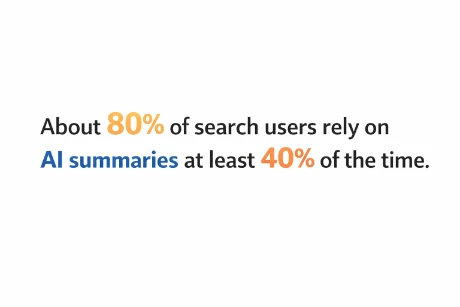
UGC is, therefore, a structural advantage across both classic search results and AI-enhanced environments. It strengthens long-term visibility in a way purely branded copy simply can’t.
The nine tactics below form a practical, execution-focused framework for turning user-generated content into measurable search engine optimization performance.
Each approach is built to strengthen rankings, increase engagement rate, improve conversion rates, and drive cost efficiency, often across multiple performance metrics at the same time.
Publishing customer reviews directly on product pages, service pages, and location pages turns real feedback into powerful ranking assets.
As we said above, reviews naturally capture keywords through authentic customer language, expanding semantic relevance and strengthening topical depth without creating additional URLs.
Instead of producing new assets or scaling blog posts to target keyword variations, you strengthen the pages already positioned to rank. This improves visibility with minimal added cost and supports stronger search engine optimization performance.
Take, for example, cold-press juicer brand, Hurom.
They write blog reviews about their own products, where they feature real customers pros and even cons that target specific keywords. In this case, we can notice: lightweight, portable, and easy to clean.
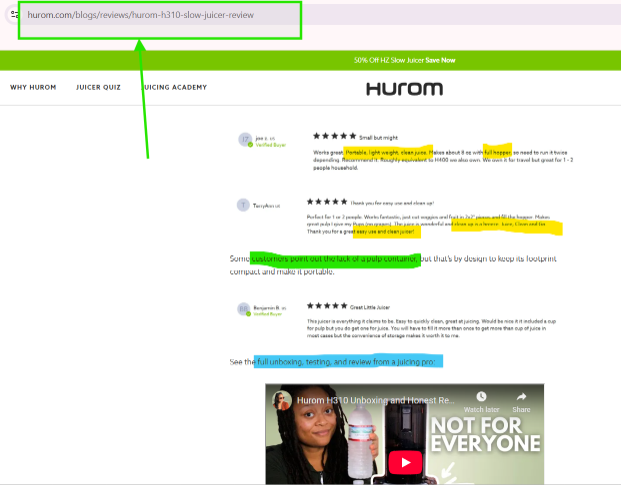
They also include video testimonials from juicing experts, surrounding them with keyword-rich phrases like “full unboxing, testing, and review.”
After all, reviews don’t just help rankings. They influence revenue.
Research from the Spiegel Research Center found that displaying reviews can increase conversion rates by up to 270% for lower-priced products, reducing friction between discovery and purchase.
To unlock stronger visibility in the organic SERP, implement review structured data using proper schema markup and follow Google’s review snippet guidelines. Then validate your setup with the Rich Results Test to ensure everything is eligible for enhanced listings.
Star ratings can improve click-through rates, strengthen engagement signals, and drive measurable ROI without increasing content production workload.
High-value category and feature pages tend to lose momentum when they get old.
Integrating user-generated content:
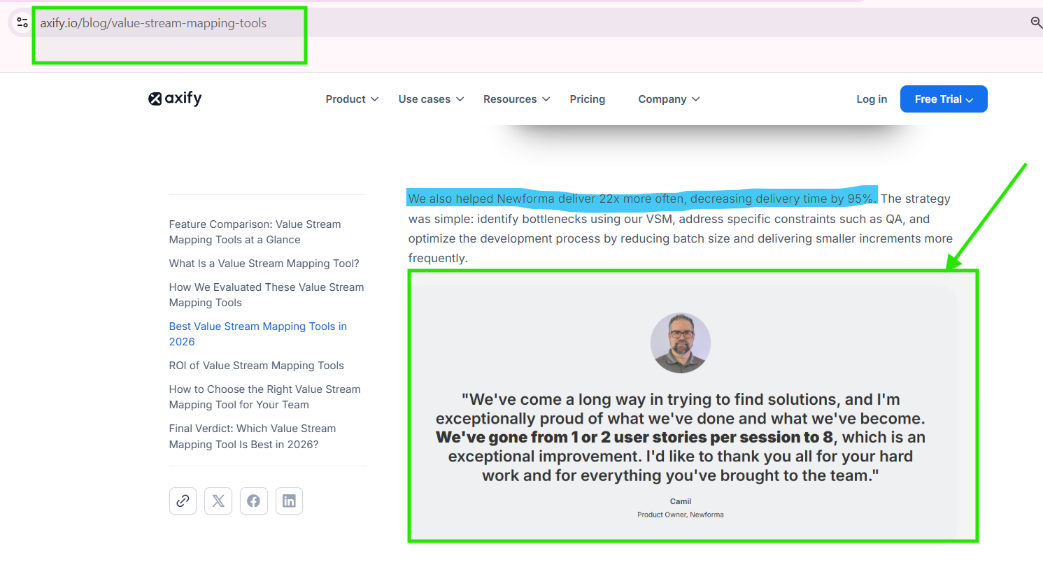
For example, software engineering platform Axify, included this quote from one of their clients (Newforma) in a blog post about Value Stream Mapping tools.
The spot matters: Axify included this quote right after discussing the results their VSM got Newforma.
Customer Q&A sections turn real pre-purchase questions into indexable user-generated content that improves search visibility and organic reach.
Instead of analyzing your competitors to pick topics for new blog posts, you’re analyzing your own audience.
Basically, you transform on-page discussions into structured FAQs that align directly with search intent and People Also Ask-style queries.
Here’s the main advantage:
Because customers phrase questions naturally, Q&A modules surface long-tail keywords that expand topical depth. This strengthens semantic relevance while reducing keyword cannibalization across product pages and category pages. This is a smarter alternative to spinning up thin content just to chase variations.
Dashing Diva does this right.
In a blog post on how to apply nail wraps, it features the following FAQ taken from studying their audience’s pain points:

Embedding UGC-driven FAQs into core pages has other advantages, too:
Strategically embedding customer reviews, customer testimonials, and discussion modules throughout product pages increases interaction.
Static brand copy can’t achieve the same results.
Pro tip: Instead of burying UGC at the bottom, place it near pricing sections, comparison tables, and objection-heavy areas to encourage scrolling and deeper exploration.
For example, Thrive Marketing Agency places its customer reviews prominently on their homepage. People don’t need to scroll to reach them and they’re all focused on results:
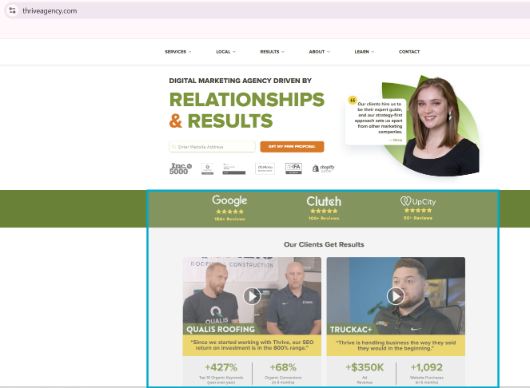
This boosts brand perception, engagement rate, and time on page, reinforcing positive content satisfaction signals for search engines.
According to PowerReviews, visitors who interact with reviews convert at a significantly higher rate (about 108% lift vs. those who don’t), demonstrating clear revenue impact and stronger conversion rates.
Remember: Dwell time alone won’t guarantee ranking gains.
But stronger engagement signals can:
“X vs Y” and “Is X worth it?” queries usually require heavy internal research and manual drafting.
Instead of building every comparison page from scratch, pull language directly from customer reviews, customer testimonials, and real-world feedback that references competitors, alternatives, and value perceptions.
This approach:
This strengthens rankings, credibility, and overall search engine optimization performance at the same time.
Hurom does this right, again:

As you can see, the cold-press juicer brand asks the right questions using their target audience’s language.
Search quality systems increasingly prioritize real experience and credibility. Embedding user-generated content that reflects first-hand usage reinforces E-E-A-T signals directly on ranking pages.
As such, it strengthens overall search engine optimization performance.
There are two main advantages here:
A common SEO mistake is launching new pages for every variation: “best X for beginners,” “X for small teams,” “X for remote teams,” and so on. Over time, this creates internal competition, diluted authority, and crawl inefficiency.
User-generated content offers a smarter path.
Instead of creating separate URLs for every edge case, integrate customer reviews, testimonials, and Q&A directly into your primary product or category pages. Real users naturally reference use cases, industries, objections, and comparisons inside a single authoritative URL.
For example, a SaaS product page might include reviews from startups, enterprises, and agencies, each describing different workflows and benefits. Rather than splitting these into separate landing pages, the consolidated UGC strengthens topical breadth within one ranking asset.
This approach:
Instead of scaling page count, you scale contextual depth. And that’s usually the more durable way to win competitive search results.
Traffic is expensive to earn. The real leverage comes from what happens three seconds before someone clicks “Buy.”
As we explained above, user-generated content works best when it appears at friction points.
For example, on many high-performing ecommerce sites, you’ll see short review snippets placed directly under the “Add to Cart” button or near pricing tables:
That positioning answers objections at the exact moment they arise.
Burt’s Bees, for example, places its average star rating and review highlights near the top of the product page, so shoppers see social proof before and near the point they decide to buy.
This is usually above or alongside the pricing and add-to-cart area.

Plus, they feature real user reviews immediately below, giving even negative reviews a prominent place:
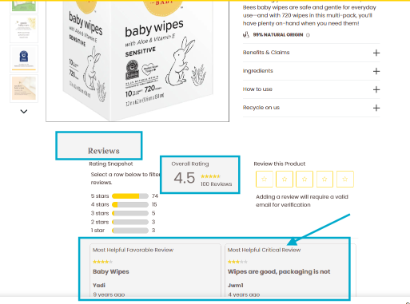
This puts UGC in a psychologically strong spot right before the key conversion action.
Even SaaS brands do this well.
On pricing pages, they place a testimonial directly under the plan comparison table, reinforcing ROI or ease of onboarding right before checkout.
Remember: When objections are resolved on the same ranking page, you increase revenue per organic visitor without increasing traffic. That’s where real SEO ROI compounds.
Most SEO strategies start with keyword tools. But keyword tools show demand after it stabilizes.
User-generated content shows intent while it’s forming.
Reviews, Q&A threads, support comments, and testimonial transcripts reveal:
Once you find them, you can analyze patterns inside your own ecosystem.
For example, if multiple reviews mention “portable for small kitchens” or “great for apartment living,” that may signal an opportunity to reposition an existing product page section or update metadata to reflect that demand.
For juicer brand Tuumiist, you can notice the same keywords repeated:

UGC becomes a diagnostic layer. It tells you where your messaging misaligns, where search intent is shifting, and where to deepen existing assets instead of expanding blindly.
Tools like Google Search Console and review analytics platforms help surface this search marketing data efficiently.
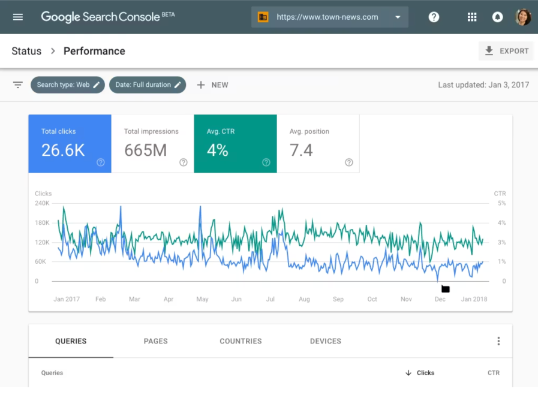
Remember: Using UGC as an insight engine can improve rankings, engagement rates, and even brand loyalty in the long term. This makes your search engine optimization strategy more responsive and cost-efficient, and grounded in actual real user behavior.
Tactics drive quick wins. Systems drive scale.
Sustained ROI from user-generated content requires structured collection, governance, and controlled automation within your broader search engine optimization framework.
Consistent UGC starts with intentional collection flows. Instead of relying on ad hoc submissions, build repeatable inputs across your ecosystem:
Automation platforms can streamline capture and reduce manual follow-up while increasing submission volume.
Don’t overlook owned channels either:

Sync resolved tickets and recurring questions into moderated on-page modules to surface common objections and emerging themes.
When connected to a customer data platform, review requests can be segmented by product, lifecycle stage, or behavior. This improves response quality and turns everyday feedback into scalable SEO inputs.
Not all UGC should go live.
Filtering spam, duplicate submissions, and low-value comments protects brand credibility and reinforces technical SEO integrity.
Clear moderation standards that are aligned with permissions and UGC rights policies will reduce risk when featuring customer photos or testimonials across product listings and other high-visibility pages.
Remember: All this is important to maintaining compliance and preserving the trust signals that influence rankings and conversion rates.
Automation speeds up publishing workflows, structured data tagging, and syndication across marketplace listings. It reduces manual workload and supports scalable expansion across your digital marketing ecosystem.
But oversight matters, especially when:
Automation drives cost efficiency. Governance protects search visibility.
Together, structured pipelines and controlled automation transform UGC from ad hoc contributions into a resilient, operational SEO system.
UGC ROI should be tracked, attributed, and optimized continuously to ensure sustained impact across rankings, engagement, and revenue.
Even well-intentioned teams undermine ROI by mismanaging user-generated content inside their broader search engine optimization efforts.
UGC drives ROI only when it’s structured, visible, indexable, and supported by disciplined SEO oversight.
And that’s the kind of execution that requires a dedicated growth partner.
User-generated content is a compounding search engine optimization asset.
When embedded into high-impact product pages, customer reviews, Q&A, and real customer insights continuously expand long-tail keywords, strengthen trust, and lift conversion rates without increasing acquisition costs.
The real advantage comes from disciplined integration, clean governance, and ongoing measurement.
If you want expert help turning UGC into a scalable SEO growth engine, our team at inBeat Agency can help you structure, deploy, and optimize a performance-driven system that turns organic visibility into measurable revenue. Book a call today and let us help you.
User-generated content expands long-tail keywords through natural customer language. Customer reviews, Q&A sections, and customer testimonials deepen semantic coverage on product pages and category pages, improving relevance in search results while strengthening engagement rate and conversion rates.
Yes. UGC enhances on-page relevance, freshness, and trust signals, all of which influence search engine optimization performance. Implementing review structured data with proper schema markup can also unlock enhanced listings in the organic SERP, increasing click-through rates.
When properly moderated, UGC is both safe and valuable to index. Spam filtering, quality controls, and strong technical SEO practices ensure search engines can crawl and evaluate content without harming site integrity.
Customer reviews, Q&A modules, customer stories, and moderated community discussions perform best. They capture long-tail intent, address real buyer objections, and support stronger conversion rate performance directly within ranking pages.
Track rankings, organic traffic growth, engagement rate, assisted conversions, and revenue per organic session. Comparing performance before and after integrating user-generated content helps quantify both SEO impact and measurable revenue lift.
